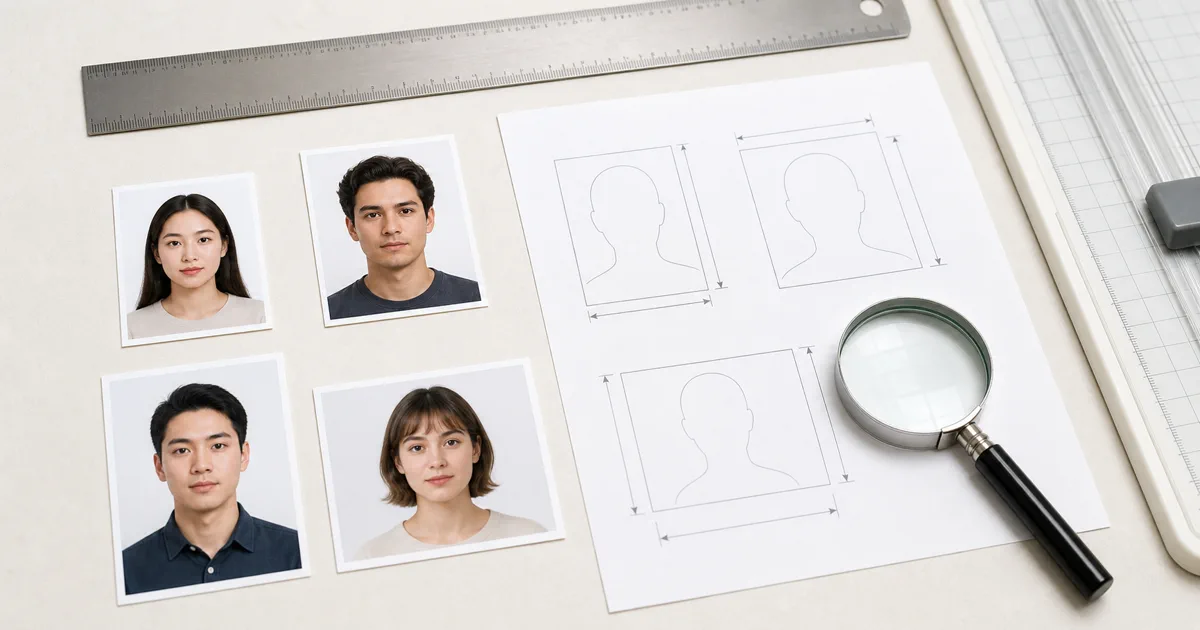
The Schengen visa is the most applied-for visa in the world, with over 16 million applications every year. And every single one of them requires a photo that meets strict ICAO biometric standards. Whether you are applying for a tourist visa, business visa, or student visa, the photo rules are the same across all 29 Schengen member states. Here is exactly what you need.
Quick Specs at a Glance
| Size | 35 x 45 mm (3.5 x 4.5 cm) |
| Head height | 32 x 36 mm (70 x 80% of frame) |
| Background | White or light grey (varies) |
| Expression | Neutral, mouth closed |
| Glasses | Most countries allow (no glare) |
| Recency | Taken within last 6 months |
| Quantity | 2 identical photos |
| Color | Color (not black & white) |
| Print quality | High quality, matte or glossy |
Size Requirements
The Schengen visa photo size is 35 x 45 mm (3.5 x 4.5 cm). This is the standard European passport photo format, which is taller and narrower than the 2 x 2 inch American format.
In pixels (for digital submissions)
At 300 DPI: 413 x 531 pixels. At 600 DPI: 827 x 1063 pixels. Most online applications accept any resolution above 400 pixels wide.
Within the 35 x 45mm frame, your face must occupy 70 x 80% of the photo. In practice this means:
- Head height (chin to crown): 32 x 36 mm
- Face position: Centered, looking straight at the camera
- Top of head: Small gap between top of hair and edge of photo
- Chin: Fully visible, not cropped
- Shoulders: Partially visible at the bottom
Background Color Rules
The standard requirement is white or light grey, but there are minor variations across Schengen states:
- White: Accepted by all 29 countries - the safest choice
- Light grey: Accepted by most countries including Germany and the Netherlands
- Light blue: Accepted by France, but not universally
When in doubt, use a plain white background. No consulate has ever rejected a photo for having a white background. The background must be uniform - no gradients, patterns, shadows, or visible objects.
Expression and Pose
All Schengen countries follow ICAO standards for facial expression and positioning:
- OK Neutral expression with mouth closed
- OK Both eyes open and clearly visible
- OK Face looking directly at the camera
- OK Head straight - not tilted or turned
- No No smiling, frowning, or raised eyebrows
- No No mouth open or teeth visible
- No No squinting or closed eyes
A slight natural expression is acceptable - you do not need to look completely emotionless. But anything beyond a subtle resting face can trigger a rejection. Our guide to smiling in passport photos has more detail on what is allowed.
Clothing and Accessories
Glasses: Most Schengen countries still allow prescription glasses, but the trend is moving toward banning them. France, Germany, and the Netherlands recommend removing glasses. If your glasses cause any glare, reflection, or partially hide your eyes, they will be rejected. The safest option is to remove them entirely. See our complete glasses guide for country-specific rules.
Headwear: Not allowed unless worn for religious or medical reasons. Even in those cases, the face must be fully visible from the bottom of the chin to the top of the forehead. No shadows from the headwear should fall on the face.
Clothing: Wear normal everyday clothes. Avoid white tops - they can blend into the white background. No uniforms (military, police, airline) unless worn daily for religious reasons.
Jewelry and piercings: Generally allowed as long as they do not obscure the face. Avoid large dangling earrings that create shadows.
Country-by-Country Differences
While the core requirements are the same, here are the minor variations across the most popular Schengen destinations:
| Country | Size | Background | Glasses | Details |
|---|---|---|---|---|
| France | 35 x 45mm | White/light blue | Remove | Full guide |
| © Germany | 35 x 45mm | White/light grey | Remove | Full guide |
| Italy | 35 x 45mm | White | Allowed (no glare) | Full guide |
| Spain | 35 x 45mm | White | Allowed (no glare) | Full guide |
| Netherlands | 35 x 45mm | Light grey | Remove | Full guide |
| Portugal | 35 x 45mm | White | Allowed (no glare) | Full guide |
| Poland | 35 x 45mm | White | Allowed (no glare) | Full guide |
| Austria | 35 x 45mm | White/light grey | Allowed (no glare) | - |
| Greece | 35 x 45mm | White | Allowed (no glare) | - |
| Czech Rep. | 35 x 45mm | White | Remove | - |
For the full list of all 29 Schengen countries, see our Schengen photo requirements page.
Schengen vs Other Regions
| Specification | Schengen | US | UK | India |
|---|---|---|---|---|
| Size | 35 x 45mm | 51 x 51mm | 35 x 45mm | 51 x 51mm |
| Background | White | White | Light grey | White |
| Glasses | Varies | Banned | Allowed | Allowed |
| Smile | No | No | No | No |
| Quantity | 2 | 2 | 2 | 2-4 |
The key difference is size. The Schengen 35 x 45mm format is rectangular and taller than the American 51 x 51mm square format. You cannot use a US passport photo for a Schengen application without resizing and reformatting it. Our size guide covers dimensions for 50+ countries.
How to Create a Schengen Visa Photo
At a photo studio: Most photography shops in Europe and major cities worldwide know the 35 x 45mm format. The cost ranges from $5 to $15 depending on your location.
Free at home:
- 1 Stand in front of a white wall with natural daylight coming from a window
- 2 Have someone photograph you straight on (phone camera at eye level)
- 3 Upload to VisaPicPro and select your Schengen destination country
- 4 The tool auto-crops to 35 x 45mm, sets the correct head height, and removes the background
- 5 Download and print the 4 x 6 layout at any photo printer - you get 8 photos on one print
Frequently Asked Questions
What size photo is required for a Schengen visa?
What background color is needed for a Schengen visa photo?
Can I wear glasses in a Schengen visa photo?
How many photos do I need for a Schengen visa?
Are Schengen visa photo requirements the same for all countries?
Create Your Schengen Visa Photo Free
Select any Schengen country, upload your photo, and get a perfectly formatted 35 x 45mm photo ready to print. Free, no signup.
Create Schengen Photo FreeFree Tools
ICAO Photo Checker
Verify ICAO compliance for Schengen
Visa Photo Checker
Check size, background & expression
Photo Resizer
Resize to 35 x 45mm at 300 DPI
DPI Converter
Convert between DPI, pixels & mm
Related Articles
Can You Smile in a Passport Photo?
Expression rules for US, UK, and Schengen passports.
Glasses in Passport Photos
Which countries ban glasses and which allow them.
Passport Photo Size Guide
Dimensions for 50+ countries in mm, cm, and pixels.
Passport Photo Dress Code
What to wear and what to avoid in passport photos.